Free Roofing Estimate Template for Contractors

A roofing estimate template should help a contractor turn field information into a price that the crew can deliver and the customer can understand. The document needs more than a total. It should preserve the measurement assumptions, material scope, labor allowances, exclusions, customer choices, payment expectations, and approval trail behind that total.
Use this guide as a practical structure for residential replacement estimates. Adapt the wording to your company, market, supplier practices, insurance requirements, and legal advice. The goal is a repeatable estimating workflow, not a generic form that hides important decisions.
Roofing estimate template sections that belong in every draft
Start with the information another estimator would need to understand the opportunity without calling the original salesperson. That standard makes the estimate easier to review, revise, hand off, and defend when a homeowner asks why the price changed.
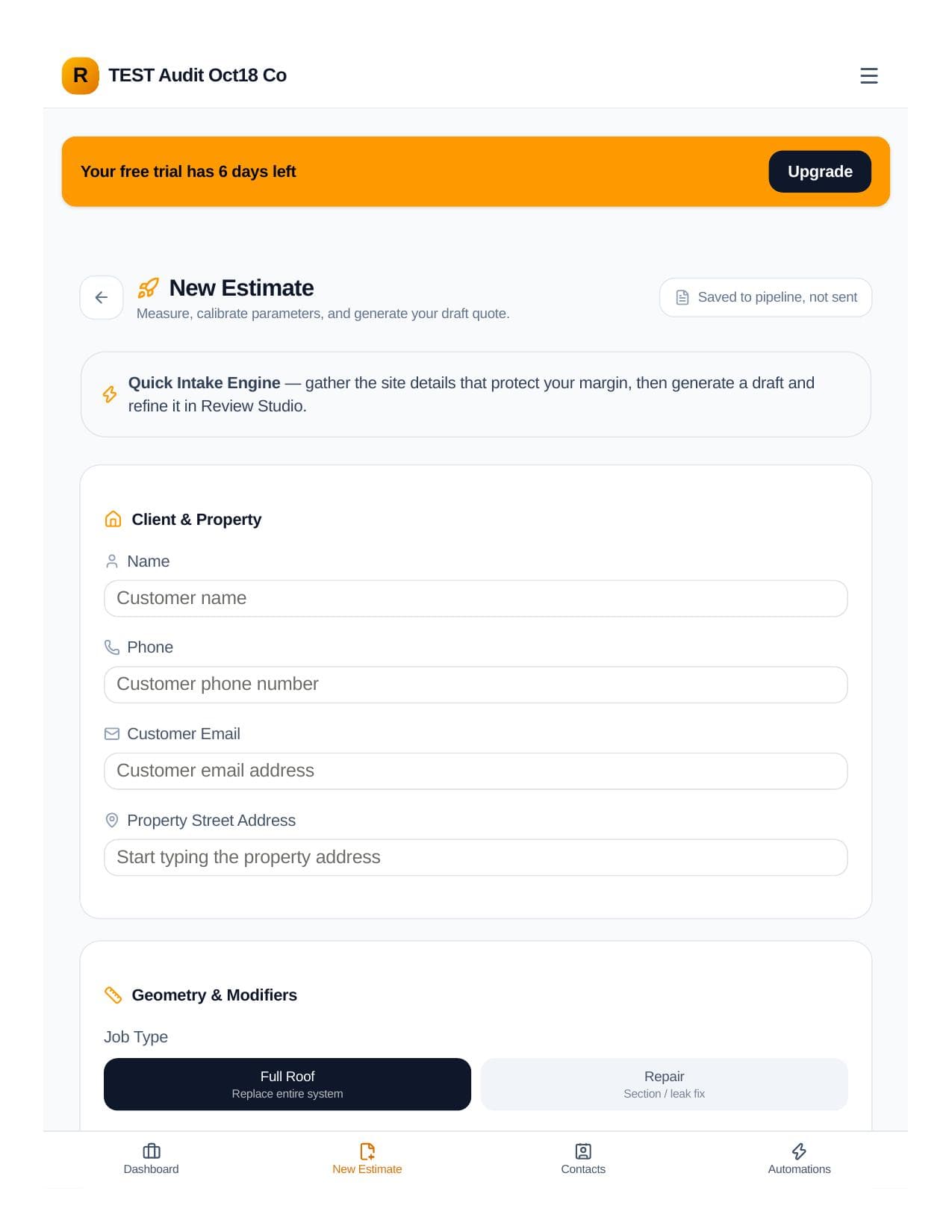
The opening block should identify the customer, property, estimator, and estimate status. Keep contact information separate from the technical scope so office staff can update a phone number without touching the pricing assumptions.
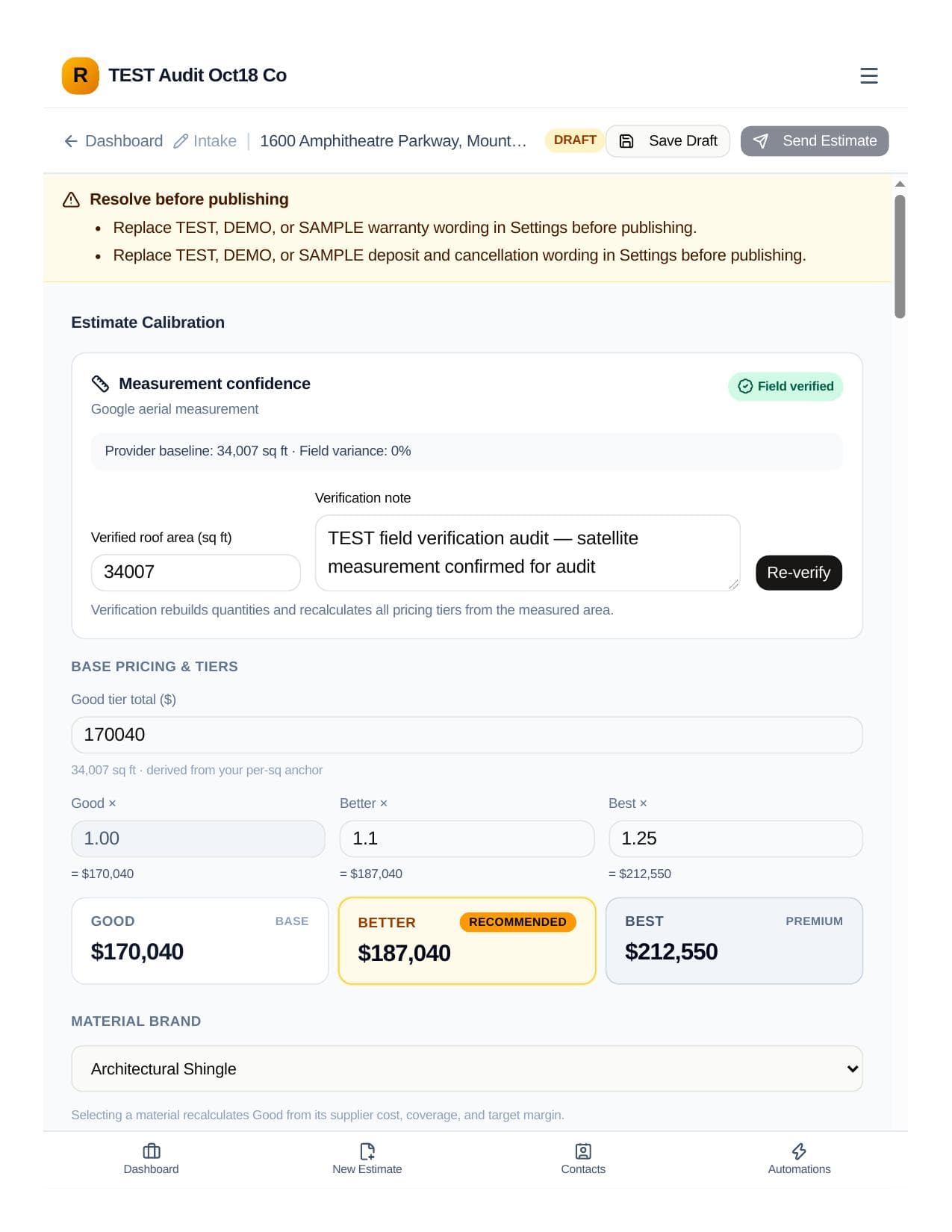
Then capture the roof conditions that influence the work. Record where each input came from, whether it is preliminary, and whether a field check is still required. RoofHQ supports a review workflow in which preliminary measurements can be checked before the estimate moves forward, while its pricing logic keeps the customer options tied to the same base estimate [2].
Your intake block should cover:
- Property details: service address, customer contact, access notes, and the person authorized to approve work.
- Measurement source: field measurement, aerial result, supplied report, plan set, or another named source.
- Roof conditions: roof form, pitch profile, stories, existing layers, valleys, penetrations, and ventilation observations.
- Scope assumption: replacement, repair, inspection, emergency work, or a clearly defined combination.
- Verification status: what has been confirmed and what remains subject to an on-site check.
Treat the estimate as a chain of evidence. If a measurement changes, the material quantities and price should be recalculated from the verified input. Do not leave the old price beside a new roof area and assume someone will notice the mismatch.
For a closer look at that handoff, review the roof measurement workflow before adapting the template.
Build the cost worksheet before writing the customer scope
A customer-facing estimate should be clear, but it cannot be reliable if the internal worksheet is incomplete. Build the cost side first. The scope and presentation should describe the same job represented by the material, labor, disposal, equipment, overhead, and risk allowances.
Use separate worksheet rows for items that behave differently when the roof changes. Shingles may scale with roof area and package coverage.
Flashing may depend on measured lengths or counted details. Disposal may depend on roof size and tear-off conditions.
Labor may respond to pitch, height, access, staging, and crew productivity.
Avoid one miscellaneous material allowance that absorbs every omission. It makes the estimate hard to calibrate because you cannot tell whether a variance came from shingles, accessories, decking, delivery, or waste.
A worksheet structure your team can review
| Cost group | Record in the worksheet | Review before pricing |
|---|---|---|
| Measurements | Source, roof area, pitch, edges, valleys, and counted features | Confirm the source and unresolved field checks |
| Materials | Catalog item, purchase unit, coverage, quantity, waste basis, and supplier cost | Confirm that every item exists in the approved catalog |
| Labor | Crew task, production assumption, access condition, and labor rate | Confirm that difficulty adjustments match the job |
| Site costs | Delivery, disposal, protection, permits, equipment, and cleanup | Confirm which charges are included or excluded |
| Risk items | Decking, flashing, ventilation, and other concealed conditions | State the approval process for additional work |
| Price review | Hard cost, overhead treatment, target return, and customer price | Confirm that the selling price follows company policy |
The distinction between markup and margin matters during this review. A contractor can use the profit margin calculator to compare a proposed selling price with the cost basis without putting internal cost details on the homeowner document.
RoofHQ includes pricing logic that checks hard cost and a configured minimum-margin policy before producing tier totals [4]. That safeguard is useful only when the underlying costs are complete, current, and tied to the correct material quantities.
Keep supplier units visible
Quantities should reflect what the supplier sells, not only an abstract roof-area allowance. Record bundles, rolls, boxes, sticks, pieces, sheets, or other purchase units where appropriate. Keep coverage and rounding rules with the catalog item so an estimator can understand why the purchase quantity differs from the exact calculated need.
When a supplier price changes, update the catalog cost and recalculate the estimate. Do not type over the customer total and leave the material worksheet stale. A strong template keeps the source cost, estimated quantity, and selling-price decision connected while still allowing an authorized contractor to make a deliberate manual adjustment.
Turn the worksheet into a scope a homeowner can understand
The public document should answer what work will happen, what materials are included, what choices are available, what could change, and how acceptance works. It should not expose private labor rates, wholesale costs, margin targets, or internal notes.
Write the scope in job order. Describe protection and setup, removal, deck review, installation, ventilation or flashing work, cleanup, inspection, and closeout. Use the actual material selection rather than broad marketing language that could describe a different system.
Separate included work from allowances and exclusions
Ambiguity is expensive. Put included work, optional work, allowances, and exclusions in distinct blocks. If damaged decking cannot be confirmed until tear-off, describe how the condition will be documented, priced, and approved before the crew proceeds.
Use plain language for terms that a homeowner may not know. Explain what underlayment, ridge caps, drip edge, flashing, and ventilation components do in the context of the proposed roof. Avoid turning the estimate into a manufacturer brochure; the scope should explain the contractor's commitment.
The roofing estimating software workflow shows how intake information, measurements, material quantities, tier pricing, and proposal review can remain connected instead of living in separate documents.
Present customer choices without creating three unrelated estimates
Good, better, and best options work when every option solves the same defined roofing problem and the differences are easy to compare. The tiers should share the core removal, preparation, installation, cleanup, and workmanship commitments unless the proposal clearly says otherwise.
Change only the components or service levels that genuinely differ. Those differences may include a material system, accessory package, ventilation scope, protection detail, or contractor-authored warranty term. Do not use vague labels as a substitute for a written scope.
RoofHQ's tier logic keeps the selected options tied to a common estimate and marks the middle option as the recommended presentation when a complete tier set is available [2]. Proposal calculations then combine the chosen tier with selected add-ons before producing the customer total [5].
Use a comparison block like this:
| Customer decision | Good | Better | Best |
|---|---|---|---|
| Core replacement scope | Clearly listed | Same core scope | Same core scope |
| Roofing system | Named base system | Named upgraded system | Named premium system |
| Accessories | Included items listed | Upgrades identified | Premium upgrades identified |
| Warranty | Contractor wording | Contractor wording | Contractor wording |
| Optional work | Shown separately | Shown separately | Shown separately |
The table should describe real differences from the estimate. Never let a generic feature list promise a product, warranty, or accessory that the contractor has not selected for the job.
Add terms that make acceptance operationally useful
The last section should explain what the customer is accepting and what happens next. Include the estimate validity language your company uses, the payment schedule, deposit and cancellation terms, warranty policy, change-order process, concealed-condition process, scheduling expectations, and signature block.
Payment language should match the workflow used by the office. RoofHQ's payment-schedule logic derives the remaining material and completion portions from the configured deposit policy so the schedule stays internally consistent [6]. The contractor remains responsible for the wording presented to the customer.
Before sending, perform a final review:
- Identity check: verify the customer, property, contractor, and estimate owner.
- Measurement check: confirm the source, confidence, and field-verification status.
- Quantity check: confirm that purchase units and catalog items match the scope.
- Price check: confirm cost inputs, pricing policy, options, add-ons, and tax treatment.
- Document check: confirm scope, exclusions, warranty, payment terms, and approval language.
- Delivery check: preview the exact public proposal the homeowner will receive.
Once the estimate is sent, preserve the version the customer reviewed. If the scope or price changes, create a clear revision instead of silently changing the accepted document.
Questions contractors ask before using a roofing estimate template
What should a roofing estimate include besides the total?
Include the measurement basis, material system, labor scope, site protection, removal and disposal, accessories, cleanup, exclusions, concealed-condition process, warranty, payment terms, and acceptance method. Keep internal cost and margin details in the contractor worksheet rather than the homeowner proposal.
How should a contractor handle uncertain roof measurements?
Label the measurement source and confidence clearly, then require field verification before publishing or ordering materials when the source is uncertain. Recalculate quantities and pricing from the verified roof area so the estimate does not preserve stale assumptions.
Should optional upgrades be included in the base estimate?
Keep genuine optional work separate and show how selecting it changes the total. Core work required to deliver the promised roof should remain in the base scope rather than appearing as an option the homeowner might accidentally remove.
How often should the template be reviewed?
Review it whenever supplier pricing, labor policy, warranty language, payment terms, installation practices, or the approval workflow changes. Also review completed jobs against their estimates so recurring omissions become explicit worksheet rows instead of repeated surprises.
Put the template into a repeatable estimating workflow
A template is valuable when it makes the next estimate more consistent without hiding job-specific judgment. Keep measurement evidence, catalog quantities, pricing decisions, scope language, options, and acceptance connected. That gives the salesperson a cleaner review process, the production team a clearer handoff, and the homeowner a document that explains what they are approving.
Build your next customer-ready draft with the RoofHQ roofing estimator.
[2]: src/lib/pricing/tiers.ts [4]: src/lib/pricing/estimate-pricing.ts [5]: src/lib/pricing/proposal-totals.ts [6]: src/lib/proposals/payment-schedule.ts
Written by
Practical tips from the RoofHQ team — helping roofing contractors measure faster, quote smarter, and close more work.
Measure, quote, and get paid faster.
Try RoofHQ for free — instant satellite measurements and professional proposals in minutes.
Start FreeKeep reading

October 24, 2026
How to Estimate a Roofing Job Step by Step
Read more →

September 28, 2026
Best Roofing Software for Contractors (2026)
Read more →

September 27, 2026
Best Roofing CRM Software for Contractors (2026)
Read more →

September 23, 2026
AccuLynx Roofing Software: An Independent Review
Read more →

August 20, 2026
Good, Better, Best: Tiered Roofing Pricing
Read more →