How to Estimate a Roofing Job Step by Step

For roofing contractors learning how to estimate a roofing job, the dependable approach is a traceable workflow: verify the property and roof scope, confirm the measurement basis, build the material takeoff, enter labour and job costs, review pricing options, and inspect the customer proposal before it is sent. Each handoff should preserve the assumptions behind the price so an estimator can explain and revise it without rebuilding the job.
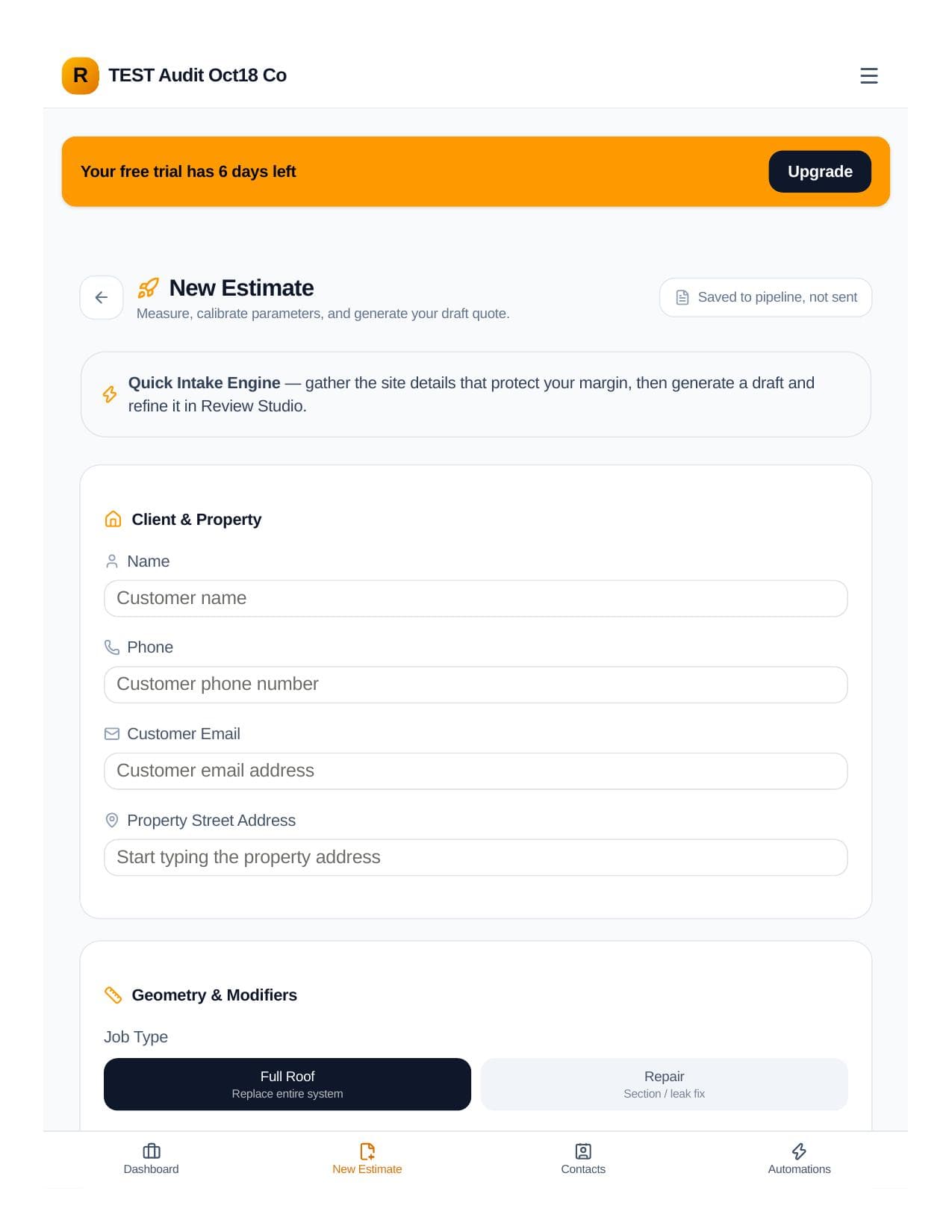
The goal is not to make an uncertain roof look certain. Preliminary aerial information can support an early estimate where the available property data supports it, but field verification remains part of the contractor's responsibility [7]. Treat the first result as a structured starting point, then replace assumptions with observations, supplier costs, and crew knowledge as the opportunity moves toward a contract.
How to estimate a roofing job from verified inputs
Begin with the job record, not with a selling price. A strong estimate should let another member of the company identify what was measured, what was assumed, what the company expects to purchase, and which decisions are still open. That record becomes the bridge between sales, production, purchasing, and the customer.
Use this sequence as the working path:
- Confirm the address, customer contact, requested scope, and roof areas that are included.
- Review the measurement source and flag every value that still needs an on-site check.
- Choose materials from the company's maintained catalogue and convert the roof scope into purchase quantities.
- Enter labour, disposal, decking, access, and other job-specific cost assumptions.
- Build the customer options from the same cost basis instead of maintaining unrelated quotes.
- Review add-ons, tax treatment, deposit terms, payment wording, and exclusions in the proposal.
- Save the approved version and keep later changes visible to the team.
That order prevents the selling price from becoming an unexplained target. RoofHQ's estimate-pricing logic validates the roof and cost inputs before it builds quote values, and its recalculation path uses material quantities together with stored wholesale costs [4]. The practical lesson is simple: if a cost input is missing or stale, correct that input before debating the final price.
Separate measured facts from estimating assumptions
Mark the source of each important input. Property data, an aerial model, a site sketch, a supplier quote, and a crew lead's production judgment do not carry the same level of confidence. Keeping them distinct makes review faster because the estimator knows which fields can be trusted and which require a visit or a phone call.
The RoofHQ measurements overview explains the role of preliminary aerial measurements in the workflow. Use that information to prepare the conversation and scope the opportunity, then confirm roof geometry, layers, access, penetrations, edge conditions, decking concerns, and the actual replacement boundary before materials are ordered.
Define scope before calculating quantities
Write the scope in operational language. State which roof sections are included, what is being removed, what is being installed, and what is specifically excluded. Note unresolved items as allowances or decisions rather than silently treating them as known. A clear scope gives every later quantity and price a reason to exist.
This is also the moment to confirm the system being estimated. Shingles, underlayment, ventilation, flashing, ridge treatment, valleys, accessories, disposal, and site protection should be considered as a connected assembly. The estimate is incomplete when it prices only the visible field material and leaves the installation system to memory.
Turn roof scope into a purchase-ready material list
A material takeoff should describe what the company expects to buy, not merely repeat roof area. Start from verified geometry, choose catalogue items, apply the package coverage and job conditions used by the company, and round to real purchase units. Keep quantities editable because a contractor may learn more during inspection or supplier review.
Try the Shingle Waste Calculator - use it as a planning aid while confirming the actual roof layout, product coverage, and purchase quantities for the job.
The material list should answer practical questions for purchasing and production. Which exact product is intended? What unit will the supplier sell? Does the quantity represent installed coverage or whole packages? Which accessories belong to the selected system? Which line reflects an allowance rather than a confirmed condition?
Keep catalogue cost and job quantity independent
Treat unit cost and quantity as separate controls. The catalogue stores the company's current wholesale cost and package logic; the job stores how much of that item is expected for this roof. When the supplier changes a cost, the catalogue can be updated. When the inspector changes a quantity, the job can be updated. Combining both changes into an unexplained lump sum makes future review harder.
RoofHQ's recalculation logic totals material lines from quantity and wholesale cost rather than trusting a client-supplied material total [4]. That pattern helps an estimator see why the estimate changed. A revised bundle count should affect the material cost because the quantity changed; a supplier increase should affect it because the catalogue cost changed.
| Estimate layer | Contractor review | Record produced |
|---|---|---|
| Roof scope | Included areas, removal, access, and open conditions | Written scope and verification notes |
| Material takeoff | Catalogue item, coverage, whole purchase unit, and allowance status | Editable purchase quantities |
| Labour plan | Crew method, production constraints, setup, and cleanup | Job-specific labour input |
| Price options | Shared cost basis, option differences, and margin review | Customer-ready tiers |
| Proposal terms | Add-ons, tax treatment, deposit, exclusions, and payment wording | Sendable proposal package |
Build labour and job costs from the way your crew works
Avoid copying a labour total simply because it worked on a different roof. The crew, access, staging, slope, height, tear-off conditions, site protection, cleanup, and travel pattern can change the work even when two roofs appear similar from above. Use company production history as a reference, then adjust it for the conditions documented on this job.
Keep labour assumptions visible beside material and disposal assumptions. A reviewer should be able to distinguish labour from materials and identify which operational condition caused a change. RoofHQ's pricing path keeps material and labour inputs as components of the job's hard-cost basis before customer tiers are calculated [4]. That separation supports a useful review conversation: is the cost change caused by supplier pricing, quantity, production effort, or scope?
Review disposal, decking, and uncertain conditions
Some costs cannot be confirmed from an early intake. Disposal needs depend on what is removed. Decking replacement depends on conditions that may not be fully visible. Access and protection requirements depend on the site. Record the current assumption and write how the final charge will be handled if field conditions differ.
Do not hide uncertainty inside a larger selling price. A documented allowance, exclusion, or approval process gives the homeowner and the production team a clearer expectation. It also lets the estimator update the estimate when inspection evidence arrives without changing unrelated parts of the quote.
Convert one cost basis into clear customer options
Good-better-best pricing should present meaningful scope or system choices, not three arbitrary totals. RoofHQ's tier logic uses a common base and supports a recommended middle option, while retaining an effective rate and quote range for review [2]. The estimator should still inspect what changes between options and confirm that every promise appears in the scope.

Name each option by the customer decision it represents. Differences may include the selected roofing system, accessory treatment, ventilation work, protection details, warranty language, or another documented scope choice. Avoid vague labels that force the homeowner to infer value from price alone.
Before sending, use the Roofing Profit Margin Calculator as a separate review aid. Compare the intended selling price with the costs and overhead assumptions your company actually uses. The calculation should inform a decision; it should not replace the estimator's responsibility to confirm scope and inputs.
Assemble the proposal from server-controlled totals
The proposal is where estimating logic becomes a customer commitment. Review the selected tier, optional add-ons, tax treatment, deposit terms, payment schedule, warranty language, exclusions, and acceptance process together. If one element changes, regenerate the customer-facing totals rather than editing a displayed amount in isolation.
RoofHQ's proposal-total logic combines the selected base price, add-ons, tax input, and tenant-configured deposit setting on the server [5]. Its payment-schedule logic also derives the remaining stages from the configured deposit input [6]. This keeps the customer view connected to the job record instead of accepting a browser-supplied total as the source of truth.
Read the proposal as a homeowner would. Confirm that the scope names the work, the options are distinguishable, optional items are genuinely optional, payment language matches company policy, and exclusions are understandable. Then compare the public proposal with the internal review screen before it is sent.
Perform a final estimate handoff before sending
The final review should be repeatable enough that another estimator can perform it. Walk through the record in the same direction the job will travel: intake, measurement, scope, materials, labour, pricing, proposal, acceptance, and payment. Resolve conflicting notes and remove stale draft language.
Use a short handoff checklist:
- Property and customer: the job belongs to the correct address and contact.
- Measurement basis: preliminary values and field-verified values are clearly identified.
- Scope boundary: included work, options, allowances, and exclusions agree across the estimate and proposal.
- Material record: every intended item comes from the maintained catalogue with a reviewable quantity and cost.
- Labour record: the input reflects this crew and this job's documented constraints.
- Pricing options: each option has a real scope difference and shares the approved cost basis.
- Proposal totals: add-ons, tax treatment, deposit terms, and payment stages match the job record.
- Customer experience: the public page is readable on a phone and provides one clear acceptance path.
Questions contractors ask before sending an estimate
What should a roofing contractor verify before pricing a job?
Verify the property, roof scope, measurement source, catalogue selections, purchase quantities, wholesale costs, labour assumptions, disposal needs, customer options, and unresolved field conditions. The reviewer should be able to trace the proposed price back to those inputs without relying on memory.
How should a contractor handle preliminary roof measurements?
Use preliminary measurements to prepare the estimate and identify what must be checked, not as permission to skip field verification. RoofHQ describes its supported aerial output as preliminary and explicitly keeps field verification in the contractor workflow [7].
When should a roofing estimate be updated?
Update it when a verified measurement, supplier cost, material quantity, labour assumption, scope decision, add-on, or proposal term changes. Save the revised job record and review the public proposal again so the customer is not shown a total based on stale inputs.
Turn the reviewed estimate into a confident proposal
A dependable estimate is not a single calculation. It is a connected record of what the contractor observed, expects to buy, expects the crew to perform, intends to charge, and promises the customer. When each stage is reviewable, revisions become controlled changes instead of last-minute guesses.
See how RoofHQ roofing estimating software connects measurements, material review, pricing options, and proposals in one contractor workflow.
[2]: src/lib/pricing/tiers.ts [4]: src/lib/pricing/estimate-pricing.ts [5]: src/lib/pricing/proposal-totals.ts [6]: src/lib/proposals/payment-schedule.ts [7]: src/lib/competitors/roofr.ts
Written by
Practical tips from the RoofHQ team — helping roofing contractors measure faster, quote smarter, and close more work.
Measure, quote, and get paid faster.
Try RoofHQ for free — instant satellite measurements and professional proposals in minutes.
Start FreeKeep reading

October 27, 2026
Free Roofing Estimate Template for Contractors
Read more →

September 28, 2026
Best Roofing Software for Contractors (2026)
Read more →

September 27, 2026
Best Roofing CRM Software for Contractors (2026)
Read more →

September 23, 2026
AccuLynx Roofing Software: An Independent Review
Read more →

August 20, 2026
Good, Better, Best: Tiered Roofing Pricing
Read more →