Roofing Markup vs Margin: The Math Explained

Roofing markup vs margin is not a wording preference. The two calculations answer different questions, and roofing contractors can reach very different selling prices when they apply the same percentage to the wrong base. Markup compares gross profit with cost. Gross margin compares gross profit with the customer price.
The practical rule is simple: build a complete job cost first, choose the result your company needs to protect, and calculate the selling price from that target. Never assume a markup percentage is also the margin percentage.
Roofing markup vs margin: the difference in one table
Both calculations begin with the same two inputs: the cost of delivering the job and the price charged to the customer. The difference is the denominator. Markup divides gross profit by cost, while gross margin divides that same gross profit by selling price [11].
| Pricing question | Calculation | What the result tells the contractor |
|---|---|---|
| How much was added to cost? | Gross profit divided by direct cost | The markup applied to the cost basis |
| How much of the selling price remains before other business expenses? | Gross profit divided by selling price | The gross margin represented by the price |
| What price reaches a target margin? | Cost divided by the amount left after the target margin | The selling price required by that target |
| What should be changed when costs move? | Rebuild the cost basis, then recalculate | Whether the existing selling price still fits the pricing policy |
The table is a decision map, not a recommendation for a particular percentage. A contractor still needs to define which costs belong in the estimate, how overhead is handled, what risk allowance is appropriate, and which margin policy fits the company.
The markup formula starts with cost
Markup percentage equals selling price minus direct cost, divided by direct cost, then multiplied by 100 [11]. It describes the amount added relative to the money required to perform the work.
That view is useful when a supplier price list or internal price book is built from cost. It is also useful when reviewing how far a proposed price sits above the job's estimated direct cost. The limitation is that markup does not describe the share of revenue that remains as gross profit.
The gross-margin formula starts with revenue
Gross margin percentage equals selling price minus direct cost, divided by selling price, then multiplied by 100 [11]. It describes gross profit as a share of the price the customer accepts.
That denominator makes margin useful for company reporting and pricing-policy checks. It also explains why a target margin cannot be reached by adding the same percentage as markup. The cost base and revenue base are different, so the percentages are not interchangeable.
A worked roofing pricing example
Consider a replacement estimate with $10,000 [11] in direct job cost. Applying a 25% [11] markup produces a $12,500 [11] selling price and $2,500 [11] in gross profit. That result is a 20% [11] gross margin, not a 25% [11] margin.
If the contractor instead targets a 25% [11] gross margin on the same $10,000 [11] cost basis, the calculated selling price before company rounding is $13,333.33 [11]. Gross profit is $3,333.33 [11], and the equivalent markup is 33.33% [11].
The example shows why the pricing label matters. The cost did not change.
The intended percentage appeared identical. Only the calculation method changed, yet the customer price moved because each formula answered a different question.
Build the cost basis before choosing either percentage
A clean formula cannot repair an incomplete estimate. Before using markup or margin, define the full cost basis for the particular roof. The worksheet should be detailed enough that another estimator can understand where the total came from and what must be field-verified.
Start with the roof information that drives quantity and production assumptions. Record the measurement source, roof area, pitch conditions, stories, access, existing layers, penetrations, valleys, disposal conditions, and any uncertainty that requires inspection. A preliminary measurement should remain visibly preliminary until a contractor confirms it in the field.
Then connect those inputs to the costs your crew will actually incur:
- Material purchases: use supplier purchase units, package coverage, waste assumptions, accessories, delivery, and current wholesale cost.
- Roofing labor: separate the base production assumption from difficulty, height, access, tear-off, protection, and cleanup adjustments.
- Job-site costs: include disposal, equipment, permits, site protection, delivery, and subcontracted work when they apply.
- Known risk items: record how decking, flashing, ventilation, or concealed conditions will be inspected and approved rather than hiding them in a vague allowance.
- Company treatment: document whether overhead is included in the cost basis, recovered through pricing, or reviewed separately under company policy.
This is where connected estimating matters. The RoofHQ roofing estimating workflow keeps measurements, material quantities, labor inputs, and tier pricing in the same review path. The formula should run on the approved version of those inputs, not on a total copied from an older spreadsheet.
Separate cost accuracy from pricing judgment
Estimating and pricing are related, but they are not the same decision. Estimating asks what it should cost to perform the defined scope. Pricing asks what the company will charge after considering its policy, capacity, risk, and commercial goals.
Keeping those decisions separate makes review easier. If a supplier cost changes, the team can update the material line and recalculate.
If management changes a pricing target, the estimator can update the policy without rewriting the roof quantities. When both are buried in one price-per-area shortcut, it is difficult to identify why a quote moved.
Verify field inputs before treating the result as final
Markup and margin calculations are only as dependable as the inputs underneath them. A contractor should verify roof area, layers, pitch, access, decking assumptions, and scope before treating the customer price as final. Review the measurement and field-verification workflow when defining that checkpoint.
The estimate should also show which items could become a change order. A pricing formula should not quietly pretend that unknown decking or concealed flashing is already known. State the process for documenting the condition, pricing it, and obtaining customer approval.
Use margin as a review control, not a substitute for estimating
A minimum-margin control can warn that a selling price no longer covers the cost basis under company policy. RoofHQ's estimate-pricing logic compares hard cost with the configured minimum-margin setting and can recalculate customer tiers from the approved base quote [4]. That control is useful as a review signal, but the contractor still owns the inputs and the final pricing decision.
A strong review shows the reason for an adjustment. If the entered customer price sits below the configured floor, the interface should identify the relevant cost basis and pricing policy before changing the quote. Silent changes are hard to audit and easy to misunderstand.
The review should follow a repeatable order:
- Confirm scope: make sure the work represented by the costs is the work described to the customer.
- Confirm quantities: check roof measurements, package coverage, purchase-unit rounding, and waste assumptions.
- Confirm current costs: review supplier, labor, disposal, delivery, and equipment inputs.
- Confirm pricing policy: identify whether the company is using markup, target margin, a minimum price, or an authorized manual price.
- Confirm presentation: ensure tier differences, add-ons, tax, deposit, and terms reflect the approved estimate.
This order prevents a margin target from becoming a blanket answer to every estimating problem. If a quantity is wrong, fix the quantity.
If a wholesale cost is stale, update the catalog. If the policy changed, document the new policy.
Only then should the customer price be recalculated.
Carry the approved price into good-better-best options
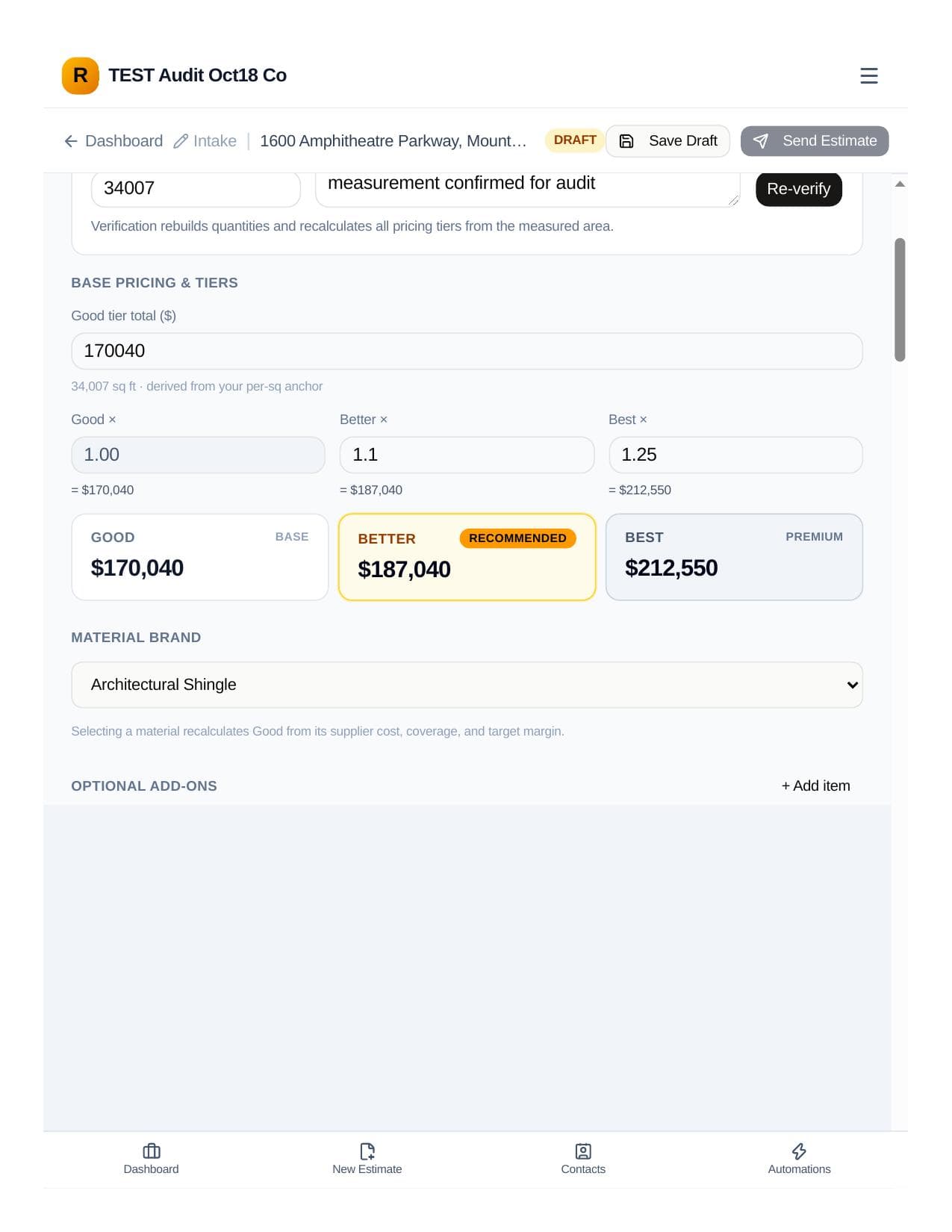
Tiered proposals should begin from one reviewed job, not from three disconnected estimates. RoofHQ's pricing logic uses the approved base quote to calculate the related customer tiers, while its proposal calculation combines the chosen tier and selected add-ons before producing the customer total [4] [5].
That structure helps the contractor preserve the pricing logic while giving the homeowner a choice. The differences between options should be real scope or system differences: material selection, accessory package, ventilation approach, protection detail, service level, or contractor-authored warranty language.
Do not use tier multipliers to hide an incomplete base estimate. Each option still depends on accurate quantities, labor, site costs, and terms. If a material is added or removed, update the cost worksheet and recalculate the estimate before changing the public proposal.
Keep internal margin data out of the homeowner proposal
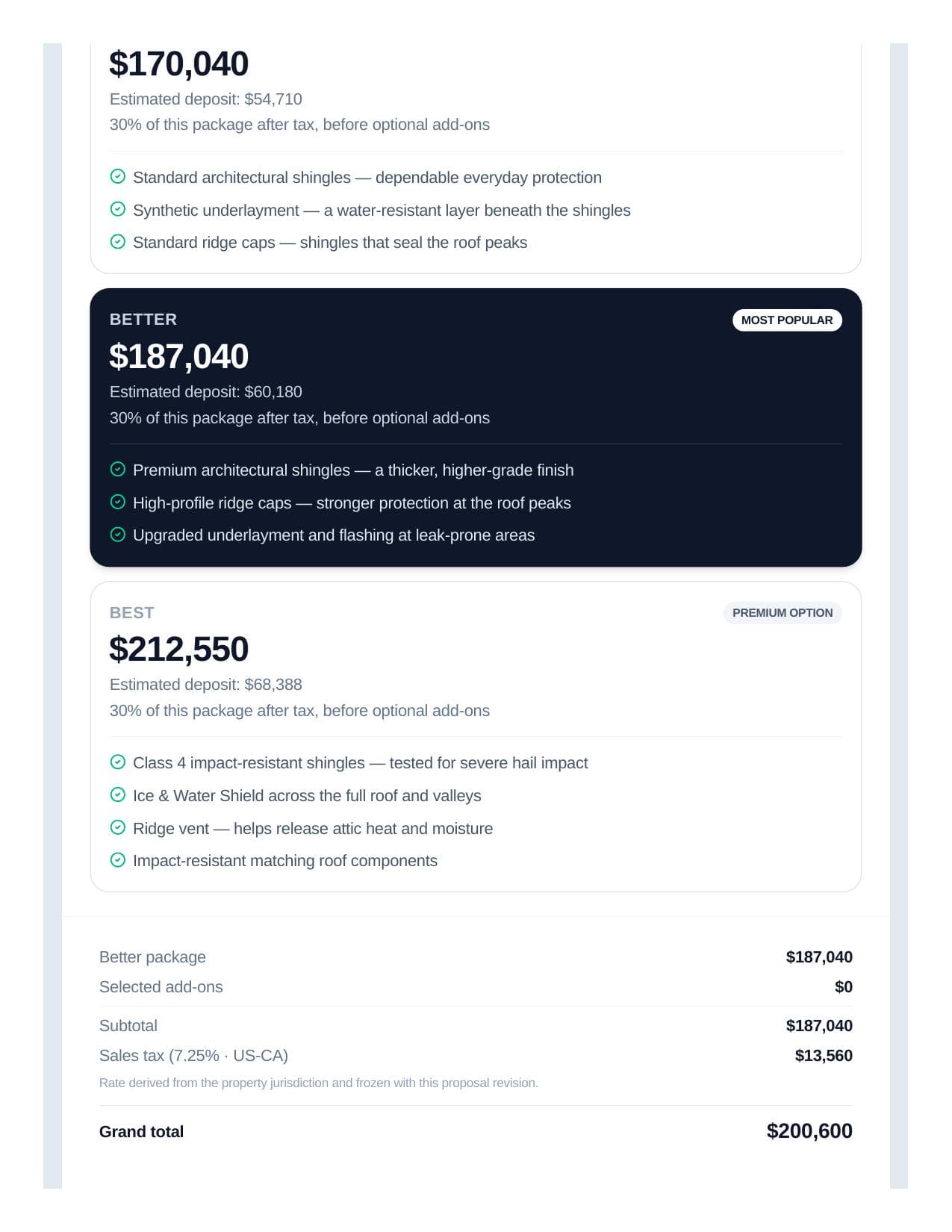
The contractor needs the cost worksheet and pricing review. The homeowner needs a clear scope, option differences, price, tax treatment, deposit, exclusions, terms, and acceptance path. Those are different views of the same approved estimate.
Once the price is approved, carry it into a customer-ready roofing proposal without exposing wholesale costs, crew rates, or the company's margin target. The proposal should explain what the customer receives and what could change, while the internal estimate preserves the audit trail behind the price.
Common roofing pricing mistakes to check before sending
The most damaging mistakes are usually process mistakes rather than difficult arithmetic. Use this review before a quote leaves the office:
- Calling markup margin: label the calculation by its denominator so the team knows which result it is reviewing.
- Applying a target to partial cost: complete the material, labor, site, and risk inputs before calculating a price.
- Using stale catalog costs: update supplier costs and purchase units before recalculating an active estimate.
- Ignoring field uncertainty: keep preliminary measurements and concealed conditions visible until they are verified.
- Overwriting a manual price silently: show the contractor when a policy floor changes an entered price and require a deliberate decision.
- Breaking the proposal link: make sure the public tiers, add-ons, tax, deposit, and terms use the same approved estimate version.
A useful pricing review should make each issue traceable. The estimator should be able to identify whether a variance came from quantity, unit cost, labor, site conditions, overhead treatment, pricing policy, or customer scope. That is more actionable than simply knowing that the final percentage missed a target.
Questions roofing contractors ask about markup and margin
Is roofing markup the same as roofing profit margin?
No. Markup compares gross profit with cost, while gross margin compares gross profit with the selling price [11].
The percentages differ because the formulas use different denominators. Label the calculation in every worksheet and software setting so estimators do not apply one while expecting the other.
Should a roofing contractor price every job to the same margin?
That is a company policy decision, not a universal rule. Job mix, scope certainty, crew conditions, supplier costs, capacity, risk, and overhead treatment can differ. The reliable practice is to define the policy, build a complete job cost, and record any authorized exception rather than copying a percentage without review.
What should be included before calculating roofing margin?
Include every cost category your company treats as part of the job's cost basis. At minimum, review materials, labor, disposal, delivery, equipment, permits, protection, subcontracted work, and known risk allowances when they apply. Document how overhead is treated so the team does not assume it is covered twice or omit it entirely.
Make the pricing decision auditable
Roofing markup vs margin becomes manageable when the team follows one chain: verify the roof inputs, calculate quantities, update real costs, apply the named pricing policy, review the result, and carry the approved price into the proposal. The calculation is short. The discipline around its inputs is what protects the estimate.
Keep the formula visible, name the denominator, and save the assumptions behind the result. When a cost or scope item changes, recalculate from the source rather than editing the public total in isolation.
Check the math before the proposal leaves the office. Use the Roofing Profit Margin Calculator with your verified costs and company pricing policy.
[4]: src/lib/pricing/estimate-pricing.ts [5]: src/lib/pricing/proposal-totals.ts [11]: content/research/roofing-markup-vs-margin.md
Written by
Practical tips from the RoofHQ team — helping roofing contractors measure faster, quote smarter, and close more work.
Measure, quote, and get paid faster.
Try RoofHQ for free — instant satellite measurements and professional proposals in minutes.
Start FreeKeep reading

October 27, 2026
Free Roofing Estimate Template for Contractors
Read more →

October 24, 2026
How to Estimate a Roofing Job Step by Step
Read more →

September 28, 2026
Roofing Contractor Software: 8 Best Tools (2026)
Read more →

September 27, 2026
Best Roofing CRM Software: 8 Tools Compared (2026)
Read more →

September 23, 2026
AccuLynx Roofing Software: An Independent Review
Read more →

August 20, 2026
Good, Better, Best: Tiered Roofing Pricing
Read more →